




This week, we added support for the new stateless MCP spec (2026-07-28), commonly referred to as MCP 2.0, to the Neon MCP server and finally retired our old Server-Sent Events (SSE) endpoints. This seems like as good a time as any to share some of our MCP usage numbers and talk about where MCP is today and where it's heading.
MCP is outgrowing our CLI
After all the CLI vs. MCP discourse online, lately folks have been sharing how fast their MCP servers are growing. Zeno Rocha shared that Resend went from 1 million MCP calls in August to 3 million in September, Max Stoiber shared that tool calls by ChatGPT users are up 98x in 2026 and we shared ours, too! It's been wild to see just how fast MCP usage is growing for us: since August, tool calls on the Neon MCP server grew about 14% week over week on average, with some weeks above 20%.
And that's even though we recommend the CLI over the MCP server in our own agent skills. The context here is that our CLI works together with neon.ts, our infra-as-code config, and it bundles, zips and deploys your Neon Functions with neon deploy. The MCP server's deploy_function tool only accepts a zip that's already built. So our skills nudge agents toward neon.ts and the CLI to make sure function deployments happen properly.
However, agents are picking the MCP server anyway! In October, 28% of all function deploys came through the MCP server instead of the CLI, including 10% from ChatGPT alone. This means ChatGPT agents are writing index.mjs files, zipping them up (I'm honestly not sure how) and then calling our MCP server to deploy them. The future is weird.
And it's not just function deploys. Here's how our remote MCP server compares to the CLI (this doesn't include our deprecated stdio package):
| Growth from December 2025 to October 2026 | Neon MCP server | Neon CLI |
|---|---|---|
| Tool calls / commands | 79x | 21x |
| Daily active users | 36x | 25x |
The MCP server overtook the CLI in daily active users last November and now has about twice as many. By August, it was also handling more tool calls than our CLI ran commands.
I think a lot of this comes down to discoverability. A harness puts the tools of every connected MCP server right in front of the model, while a CLI only gets used if the model remembers it exists or is instructed to do so via prompts, skills or AGENTS.md files. So when someone has both installed, the agent tends to reach for the MCP server first.
Agent plugins push this even further. We ship a Neon plugin for Cursor, Claude Code and Codex (npx neon@latest plugins) that bundles the MCP server with our agent skills. ChatGPT and Claude Desktop connect to Neon through the MCP server, too. In fact, those last two are now our biggest clients: in October, ChatGPT made 24% of all tool calls on mcp.neon.tech and Claude Desktop 22%, ahead of Codex (21%), Claude Code (13%) and Cursor (8%). Claude Desktop's tool calls alone grew almost 5x since August.
It's also fun to watch the share move whenever a new frontier model comes out:
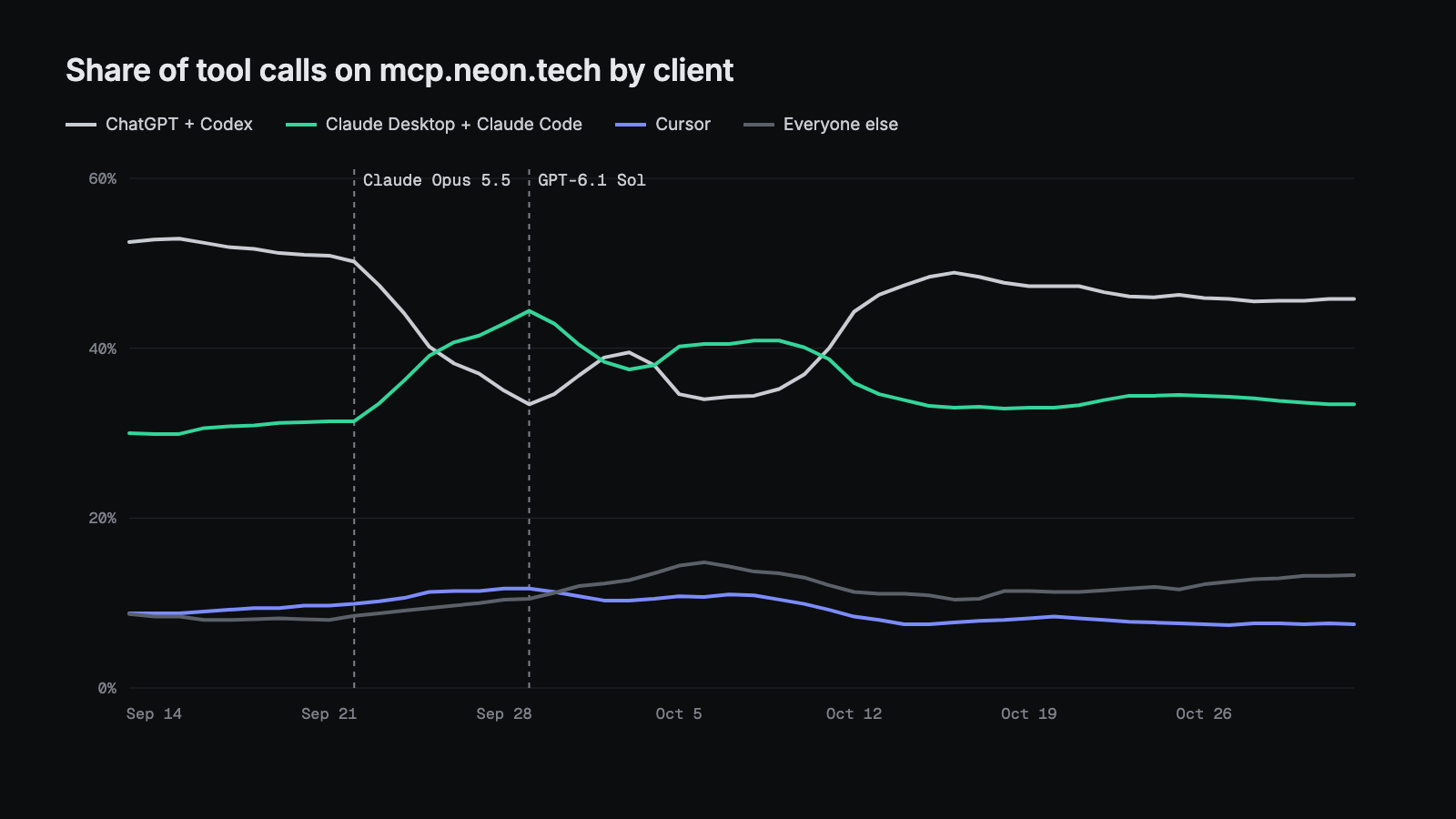
When Claude Opus 5.5 launched, Claude clients overtook ChatGPT and Codex within days. A week later, GPT-6.1 Sol flipped it right back.
So MCP is clearly winning, but is it good yet? Let's look at the timeline and where we're at today.
How we got here
MCP has gone through three designs for remote servers in just two years and we've been along for the ride:
- November 25, 2024: Anthropic open-sources MCP. Servers run locally over stdio or remotely over HTTP+SSE, which uses a long-lived SSE stream for messages from the server and a separate endpoint for the client's POST requests.
- December 3, 2024: We publish our first MCP server,
@neondatabase/mcp-server-neon, as a local stdio server on npm, just eight days after MCP launched. - March 26, 2025: Spec 2025-03-26 replaces HTTP+SSE with Streamable HTTP. Every message becomes a POST to a single endpoint and sessions live in an
Mcp-Session-Idheader. - April 4, 2025: We launch our remote MCP server at mcp.neon.tech, on SSE.
- December 19, 2025: The Transport Working Group publishes its plan for a stateless protocol, because sticky sessions and shared session stores were making remote servers hard to scale.
- February 16, 2026: We remove the local stdio server from the repo and deprecate the npm package in favor of mcp.neon.tech.
- May 21, 2026: The release candidate for 2026-07-28 comes out.
- July 28, 2026: The final spec ships and officially deprecates HTTP+SSE, with a year-long offramp.
- November 2, 2026: We add 2026-07-28 support to mcp.neon.tech and retire our SSE endpoints.
The MCP spec has come a long way and so has our own MCP offering. We were really early and have closely followed the latest developments across MCP, harness plugins and agent tooling ever since.
So what does stateless actually mean?
With the 2026-07-28 spec, the initialize handshake and the Mcp-Session-Id header are gone. Instead, every request carries its own protocol version, client info and client capabilities in _meta. That means any request can land on any server instance behind a plain round-robin load balancer.
Here's what a tools/list request against our anonymous docs endpoint looks like now:
curl 'https://mcp.neon.tech/mcp?category=docs' \
  -H 'Content-Type: application/json' \
  -H 'Accept: application/json, text/event-stream' \
  -H 'MCP-Protocol-Version: 2026-07-28' \
  -H 'Mcp-Method: tools/list' \
  --data '{
    "jsonrpc": "2.0",
    "id": 1,
    "method": "tools/list",
    "params": {
      "_meta": {
        "io.modelcontextprotocol/protocolVersion": "2026-07-28",
        "io.modelcontextprotocol/clientInfo": { "name": "example-client", "version": "1.0.0" },
        "io.modelcontextprotocol/clientCapabilities": {}
      }
    }
  }'
You get back search_docs, get_doc and send_feedback without a session id. You might have also noticed the Mcp-Method header. Requests now carry Mcp-Method and Mcp-Name headers, so a gateway or rate limiter can route requests without parsing the JSON body.
Why stateless is great news for serverless MCP servers
This is the part I'm most excited about. A lot of remote MCP servers run on serverless infra. A serverless function handles a request and the next request can land on a completely different instance. That's perfect for plain request/response, but it's a real problem for a protocol with sessions.
That's why it was common practice to pair a serverless MCP server with Redis to keep track of sessions. With HTTP+SSE, the stream stayed open on one function instance while the client's requests could land on any other, so Redis had to get those messages to the instance holding the stream. That's a lot easier to get wrong than plain request/response, and we fixed our share of session bugs over the months of maintaining the Neon MCP server.
With 2026-07-28, any function instance can handle any request and there's no session state to share. That's what makes the latest MCP spec a great fit for serverless and lets you drop the Redis dependency.
Is Streamable HTTP going away?
No, Streamable HTTP is staying. It's still one of the two standard transports next to stdio. The Transport Working Group committed to keeping it that way so every client and server can keep talking to each other out of the box.
The difference is that Streamable HTTP is now stateless. Each request stands on its own, and the server can still stream a response back over SSE when it needs to.
Which clients already support the stateless spec?
Unfortunately, not many yet. Of the six coding agents I track, Claude Code is the only one that uses 2026-07-28 by default. Codex and OpenCode support it if you opt in and the rest still use the 2025 handshake:
| Client | 2026-07-28 support |
|---|---|
| Claude Code | Default for HTTP servers since 2.1.274, stdio since 2.1.292 |
| Codex | Opt-in with mcp_2026_07_28; the default is still 2025-06-18 |
| OpenCode 2.2 | Per-server protocol setting: legacy (default), auto or 2026-07-28 |
| Cursor | No public support yet |
| Grok Build | Pinned to 2025-11-25 |
| Factory Droid | Behind a server-side flag that is off |
That's why we couldn't just switch over. Our server has to answer stateless requests and still accept the initialize handshake from every client that hasn't moved yet.
What we changed on the Neon MCP server
We made two big changes. First, we finally dropped SSE support, which also let us take Redis out of how we handle MCP requests (and that felt amazing). Second, we added support for the new spec. Most clients don't use it yet, so we still support the old spec too, but this future-proofs the Neon MCP server.
The Neon MCP server is open source, so if you're curious, you can find the full change in neondatabase/mcp-server-neon#320.
Still using our SSE endpoint?
If your MCP config still points at https://mcp.neon.tech/sse, you'll need to swap it for https://mcp.neon.tech/mcp. Update every agent on your machine by running add-mcp:
npx add-mcp https://mcp.neon.tech/mcp --name Neon -gNote: Set --name to the name of your existing Neon MCP server entry to override it. Drop -g to update a project-level config instead.
New to the Neon MCP server?
If you haven't tried the Neon MCP server yet, you can add it to every agent add-mcp detects on your machine with one command:
npx add-mcp https://mcp.neon.tech/mcp -gOn first use, your agent opens a browser window so you can sign in with OAuth. If you also want our agent skills and a linked Neon project, run npx neon@latest init instead. And if you want to use an API key, run the server in read-only mode or scope it to a single project, check out the config generator in our docs.
Every product needs an MCP server
We strongly believe that every product will need an MCP server. People want their agents to work with the services they already use, and MCP is how agents find and call those services today, in ChatGPT and Claude Desktop just as much as in a coding agent.
If you're building on Neon, adding one is pretty easy. A Neon Function can host an MCP server right next to your database, and with the new spec it doesn't need to keep any state between requests. To start a new project from our MCP starter, run:
npx neon@latest bootstrap --template mcpOr, to add an MCP server backed by your Postgres database to an existing project:
npx neon@latest functions new mcp-postgresBoth use Hono and the MCP TypeScript SDK and come with create, list, update and delete tools over Lakebase Postgres, so you can swap in your own tables or wrap the REST API you already have. You can find the template and its source on our function templates page.
So, is MCP good yet?
MCP is clearly winning and the spec keeps getting better. I'd personally say MCP is good once all the popular clients support MCP 2.0 (the 2026-07-28 spec), tool pagination and code mode! I'm tracking spec developments and client support on ismcpgoodyet.com, so check there for more details.
Happy tool calling!