> Full Neon documentation index: https://neon.com/docs/llms.txt
# Build a secure React backend with Managed Better Auth and Hono
Learn how to authenticate requests using Managed Better Auth JWTs in a custom backend for your React app.
This guide shows how to connect a **standalone React frontend** to a **custom backend API**, with [Managed Better Auth](https://neon.com/docs/auth/overview) handling identity.
Unlike frameworks that blend frontend and backend logic (like Next.js), this guide uses a decoupled architecture. You will build a React Single Page Application (SPA) that communicates with a separate Hono server via a REST API.
1. **Identity (Managed Better Auth):** Handles sign-ups, logins, and issues **JSON Web Tokens (JWTs)**.
2. **Frontend (React):** Manages the user interface and attaches the JWT to API requests as a Bearer token.
3. **Backend (Hono):** A lightweight Node.js server that verifies the token signature using Neon's **JWKS endpoint** before allowing access to the database.
This approach fits when you need a dedicated backend for complex business rules, third-party integrations (like Stripe or OpenAI), or microservices, but still want Neon to handle user management.
In this tutorial, you'll build a **Private Journal** application where users log in, create, and view their journal entries. The backend validates JWTs from Managed Better Auth so that only authenticated users can access their data.
## Prerequisites
Before you begin, make sure you have the following:
- **Node.js:** Version `18` or later installed on your machine. You can download it from [nodejs.org](https://nodejs.org/).
- **Neon account:** A free Neon account. If you don't have one, sign up at [Neon](https://console.neon.tech/signup).
## Create a Neon project with Managed Better Auth
You'll need to create a Neon project and enable Managed Better Auth.
1. **Create a Neon project:** Navigate to the [Neon Console](https://console.neon.tech) to create a new Neon project. Give your project a name, such as `journal-app`.
2. **Enable Auth:**
- In your project dashboard, go to the **Auth** page.
- Click **Enable Auth** to set up authentication for your project.
3. **Copy your credentials:**
- **Managed Better Auth URL:** Found on the **Configuration** tab of the **Auth** page (e.g., `https://ep-xxx.neon.tech/neondb/auth`).
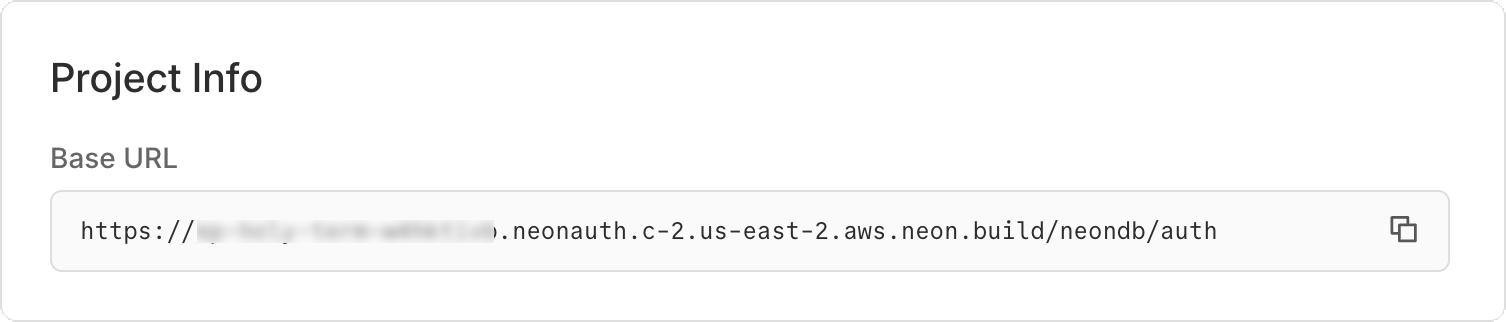
- **Database connection string:** Click **Connect** in the Console nav and copy the pooled connection string.

## Set up the backend (Hono)
You will create a Hono backend that verifies JWTs from Managed Better Auth and stores journal entries in your database.
### Initialize the backend
In a terminal, run the following commands to create a new Hono project:
```bash
npm create hono@latest journal-backend
```
> You can choose the runtime and package manager of your choice. For this guide, **Node.js** and `npm` are used.
The output should look like this:
```plaintext
$ npm create hono@latest journal-backend
> npx
> "create-hono" journal-backend
create-hono version 0.19.4
✔ Using target directory … journal-backend
✔ Which template do you want to use? nodejs
✔ Do you want to install project dependencies? Yes
✔ Which package manager do you want to use? npm
✔ Cloning the template
✔ Installing project dependencies
🎉 Copied project files
```
Navigate into the project directory:
```bash
cd journal-backend
```
### Install dependencies
You will need `drizzle-orm` and `@neondatabase/serverless` for database access, `jose` for JWT verification, and `drizzle-kit` for migrations.
```bash
npm install drizzle-orm @neondatabase/serverless dotenv jose
npm install -D drizzle-kit
```
### Configure environment variables
Create a `.env` file in `journal-backend/` with the following content. Replace the placeholders with your actual Neon database connection string and Managed Better Auth URL that you copied in the [previous step](https://neon.com/guides/react-neon-auth-hono#create-a-neon-project-with-managed-better-auth).
```env
# From Neon Dashboard
DATABASE_URL="postgresql://alex:AbC123dEf@ep-cool-darkness-a1b2c3d4-pooler.us-east-2.aws.neon.tech/dbname?sslmode=require&channel_binding=require"
# From Managed Better Auth Page
NEON_AUTH_URL="https://ep-xxx.neon.tech/neondb/auth"
```
### Set up Drizzle ORM
You'll use Drizzle ORM to work with your database.
Create `drizzle.config.ts` in the root of your `journal-backend/` folder with the following content:
```typescript
import 'dotenv/config';
import type { Config } from 'drizzle-kit';
export default {
schema: './src/db/schema.ts',
out: './drizzle',
dialect: 'postgresql',
schemaFilter: ['public', 'neon_auth'],
dbCredentials: {
url: process.env.DATABASE_URL!,
},
} satisfies Config;
```
This config tells Drizzle Kit where to find your database schema and where to output migration files. The `schemaFilter` is configured to look at both the `public` and `neon_auth` schemas. The `neon_auth` schema is where Managed Better Auth stores its user data.
### Pull Managed Better Auth schema
Managed Better Auth creates and maintains the Better Auth tables in the `neon_auth` schema. Because these tables live in your database, you can work with them directly using SQL queries or any Postgres‑compatible ORM, including defining foreign key relationships.
To integrate Managed Better Auth tables into your Drizzle ORM setup, you need to introspect the existing `neon_auth` schema and generate the corresponding Drizzle schema definitions.
This step makes Drizzle aware of the Managed Better Auth tables, allowing you to create relationships between your application data (like the `journal_entries` table) and the user data managed by Managed Better Auth.
1. **Introspect the database:**
Run the Drizzle Kit `pull` command to generate a schema file based on your existing Neon database tables.
```bash
npx drizzle-kit pull
```
This command connects to your database, inspects its structure, and creates `schema.ts` and `relations.ts` files inside a new `drizzle` folder. These files contain the Drizzle schema definitions for the Managed Better Auth tables.
2. **Organize schema files:**
Create a new directory `src/db`. Move the generated `schema.ts` and `relations.ts` files from the `drizzle` directory to `src/db/schema.ts` and `src/db/relations.ts` respectively.
```
├ 📂 drizzle
│ ├ 📂 meta
│ ├ 📜 migration.sql
│ ├ 📜 relations.ts ────────┐
│ └ 📜 schema.ts ───────────┤
├ 📂 src │
│ ├ 📂 db │
│ │ ├ 📜 relations.ts <─────┤
│ │ └ 📜 schema.ts <────────┘
│ └ 📜 App.tsx
└ …
```
3. **Add the journal entries table to the schema:**
Open `src/db/schema.ts` to view the `neon_auth` tables that Drizzle generated from your existing database schema. At the bottom of the file, append the `journalEntries` table definition as shown below. You will also need to import the missing Drizzle types at the top of the file (e.g., `bigint`).
```typescript {9,39-46}
import {
pgTable,
pgSchema,
uuid,
text,
timestamp,
unique,
boolean,
bigint,
} from 'drizzle-orm/pg-core';
import { sql } from 'drizzle-orm';
export const neonAuth = pgSchema('neon_auth');
// .. other Managed Better Auth table definitions ..
export const userInNeonAuth = neonAuth.table(
'user',
{
id: uuid().defaultRandom().primaryKey().notNull(),
name: text().notNull(),
email: text().notNull(),
emailVerified: boolean().notNull(),
image: text(),
createdAt: timestamp({ withTimezone: true, mode: 'string' })
.default(sql`CURRENT_TIMESTAMP`)
.notNull(),
updatedAt: timestamp({ withTimezone: true, mode: 'string' })
.default(sql`CURRENT_TIMESTAMP`)
.notNull(),
role: text(),
banned: boolean(),
banReason: text(),
banExpires: timestamp({ withTimezone: true, mode: 'string' }),
},
(table) => [unique('user_email_key').on(table.email)]
);
export const journalEntries = pgTable('journal_entries', {
id: bigint('id', { mode: 'number' }).primaryKey().generatedByDefaultAsIdentity(),
userId: uuid('user_id')
.notNull()
.references(() => userInNeonAuth.id),
content: text('content').notNull(),
createdAt: timestamp('created_at').defaultNow(),
});
```
The `journal_entries` table contains the following columns: `id`, `user_id`, `content` and `created_at`. It is linked to the `user` table in the `neon_auth` schema via a foreign key relationship on the `user_id` column.
### Generate and apply migrations
Now, generate the SQL migration file to create the `journal_entries` table.
```bash
npx drizzle-kit generate
```
This creates a new SQL file in the `drizzle` directory. Apply this migration to your database by running:
**Important: Issue with commented migrations**
This is a [known issue](https://github.com/drizzle-team/drizzle-orm/issues/4851) in Drizzle. If `drizzle-kit pull` generated an initial migration file (e.g., `0000_...sql`) wrapped in block comments (`/* ... */`), `drizzle-kit migrate` may fail with an `unterminated /* comment` error.
To resolve this, manually delete the contents of the `0000_...sql` file or replace the block comments with line comments (`--`).
```bash
npx drizzle-kit migrate
```
Your `journal_entries` table now exists in your database. You can verify this on the **Tables** page in the Neon Console.
### Create the Hono server
Update `src/index.ts` with the following code to set up the Hono server with JWT verification and routes for managing journal entries.
```typescript
import { serve } from '@hono/node-server';
import { Hono, type Context, type Next } from 'hono';
import { cors } from 'hono/cors';
import { neon } from '@neondatabase/serverless';
import { drizzle } from 'drizzle-orm/neon-http';
import { eq, desc } from 'drizzle-orm';
import * as jose from 'jose';
import { journalEntries } from './db/schema.js';
import 'dotenv/config';
type AppVariables = { userId: string };
const app = new Hono<{ Variables: AppVariables }>();
const sql = neon(process.env.DATABASE_URL!);
const db = drizzle(sql);
const JWKS = jose.createRemoteJWKSet(
new URL(`${process.env.NEON_AUTH_URL}/.well-known/jwks.json`)
);
const authMiddleware = async (c: Context<{ Variables: AppVariables }>, next: Next) => {
const authHeader = c.req.header('Authorization');
if (!authHeader || !authHeader.startsWith('Bearer ')) {
return c.json({ error: 'Unauthorized' }, 401);
}
const token = authHeader.split(' ')[1];
try {
const { payload } = await jose.jwtVerify(token, JWKS, {
issuer: new URL(process.env.NEON_AUTH_URL!).origin,
});
if (!payload.sub) {
return c.json({ error: 'Invalid Token' }, 401);
}
c.set('userId', payload.sub);
await next();
} catch (err) {
console.error('Verification failed:', err);
return c.json({ error: 'Invalid Token' }, 401);
}
};
app.use(
'/*',
cors({
origin: process.env.FRONTEND_URL || 'http://localhost:5173',
allowMethods: ['GET', 'POST', 'PUT', 'DELETE'],
allowHeaders: ['Content-Type', 'Authorization'],
})
);
app.get('/api/entries', authMiddleware, async (c) => {
const userId = c.get('userId');
const entries = await db
.select()
.from(journalEntries)
.where(eq(journalEntries.userId, userId))
.orderBy(desc(journalEntries.createdAt));
return c.json(entries);
});
app.post('/api/entries', authMiddleware, async (c) => {
const userId = c.get('userId');
const { content } = await c.req.json();
const [newEntry] = await db.insert(journalEntries).values({ userId, content }).returning();
return c.json(newEntry);
});
serve(
{
fetch: app.fetch,
port: 3000,
},
(info) => {
console.log(`Backend server running at http://localhost:${info.port}`);
}
);
```
The code above does the following:
1. **Server setup**
- Initializes a **Hono server** running on port 3000.
- Configures **CORS** to allow requests from `http://localhost:5173` with common HTTP methods and headers. In a production environment, adjust the CORS settings to match your frontend's domain.
2. **Database integration**
- Connects to a **Lakebase Postgres database** using the `@neondatabase/serverless` client.
- Uses **Drizzle ORM** for database operations.
- Uses the `journalEntries` schema to store and retrieve user journal data.
3. **Authentication middleware**
- Implements middleware that checks for a **Bearer token** in the `Authorization` header.
- Verifies the token against **Managed Better Auth's JWKS endpoint** using the `jose` library.
- Extracts the authenticated user's ID (`sub`) and attaches it to the request context.
- Rejects requests with invalid or missing tokens, returning `401 Unauthorized`.
4. **API endpoints**
- **GET `/api/entries`**
Retrieves all journal entries belonging to the authenticated user, ordered by creation date (newest first).
- **POST `/api/entries`**
Accepts JSON input with `content`, creates a new journal entry tied to the authenticated user, and returns the newly created entry.
Only requests with a valid token can read or create journal entries, and each user sees only their own.
### Start the backend
```bash
npm run dev
```
Your backend server should now be running at `http://localhost:3000`. Now that the backend is set up, you can proceed to create the React frontend.
## Set up the frontend (React)
Now you will build the React frontend that handles user authentication and interacts with the backend API.
### Initialize React
Open a new terminal window (leave the backend running) and create the frontend.
```bash
npm create vite@latest journal-frontend -- --template react-ts
```
When prompted:
- Select "No" for "Use rolldown-vite (Experimental)?"
- Select "No" for "Install with npm and start now?"
You should see output like this:
```plaintext
$ npm create vite@latest journal-frontend -- --template react-ts
> npx
> "create-vite" journal-frontend --template react-ts
│
◇ Use rolldown-vite (Experimental)?:
│ No
│
◇ Install with npm and start now?
│ No
│
◇ Scaffolding project in /home/journal-frontend...
│
└ Done.
```
### Install dependencies
Navigate into the project directory and install the required dependencies:
```bash
cd journal-frontend && npm install
npm install @neondatabase/neon-js@latest @neondatabase/auth-ui react-router
```
### Configure Tailwind CSS
Install Tailwind CSS and the Vite plugin:
```bash
npm install tailwindcss @tailwindcss/vite
```
Add the `@tailwindcss/vite` plugin to your Vite configuration (`vite.config.ts`):
```javascript
import { defineConfig } from 'vite';
import react from '@vitejs/plugin-react';
import tailwindcss from '@tailwindcss/vite';
export default defineConfig({
plugins: [
react(),
tailwindcss(),
],
});
```
### Configure environment variables
Create `.env` in `journal-frontend/`:
```env
VITE_NEON_AUTH_URL="https://ep-xxx.neon.tech/neondb/auth"
VITE_API_URL="http://localhost:3000/api"
```
### Initialize the auth client
Create `src/neon.ts` with the following content to initialize the Managed Better Auth client:
```typescript
import { createAuthClient } from '@neondatabase/neon-js/auth';
export const authClient = createAuthClient(import.meta.env.VITE_NEON_AUTH_URL);
```
### Update application entry point
Update `src/main.tsx` to wrap your app in the `NeonAuthUIProvider` and `BrowserRouter` to enable routing and provide authentication context throughout the app.
```tsx
import { StrictMode } from 'react';
import { createRoot } from 'react-dom/client';
import { BrowserRouter } from 'react-router';
import { NeonAuthUIProvider } from '@neondatabase/auth-ui';
import App from './App.tsx';
import { authClient } from './neon.ts';
import './index.css';
createRoot(document.getElementById('root')!).render(
);
```
### Update global styles
Replace the content of `src/index.css` with the following minimal Tailwind CSS setup:
```css
@import 'tailwindcss';
@import '@neondatabase/auth-ui/tailwind';
:root {
font-family: system-ui, sans-serif;
line-height: 1.5;
font-weight: 400;
color: #0f172a;
background-color: #f3f4f6;
text-rendering: optimizeLegibility;
-webkit-font-smoothing: antialiased;
-moz-osx-font-smoothing: grayscale;
}
body {
margin: 0;
min-height: 100vh;
background: #000000;
}
```
This also includes Managed Better Auth's Tailwind styles required for the authentication components to render correctly.
### Create auth and account pages
Managed Better Auth provides pre‑built UI components for the full authentication flow, including sign-in, sign-up, and account management.
As outlined in the [UI components reference](https://neon.com/docs/auth/reference/ui-components), you can use the `AuthView` and `AccountView` components to quickly set up these pages.
Create `src/pages/Auth.tsx`:
```tsx
import { AuthView } from '@neondatabase/auth-ui';
import { useParams } from 'react-router';
export default function AuthPage() {
const { pathname } = useParams();
return (