





When building with agents, surely you have experienced this:
- Your agent is halfway through building an app
- It needs a database, but you (the human who started the task) are no longer at the keyboard
- The next step would be a signup form, an email verification, or an API key the agent does not have - it needs you, so the work stops
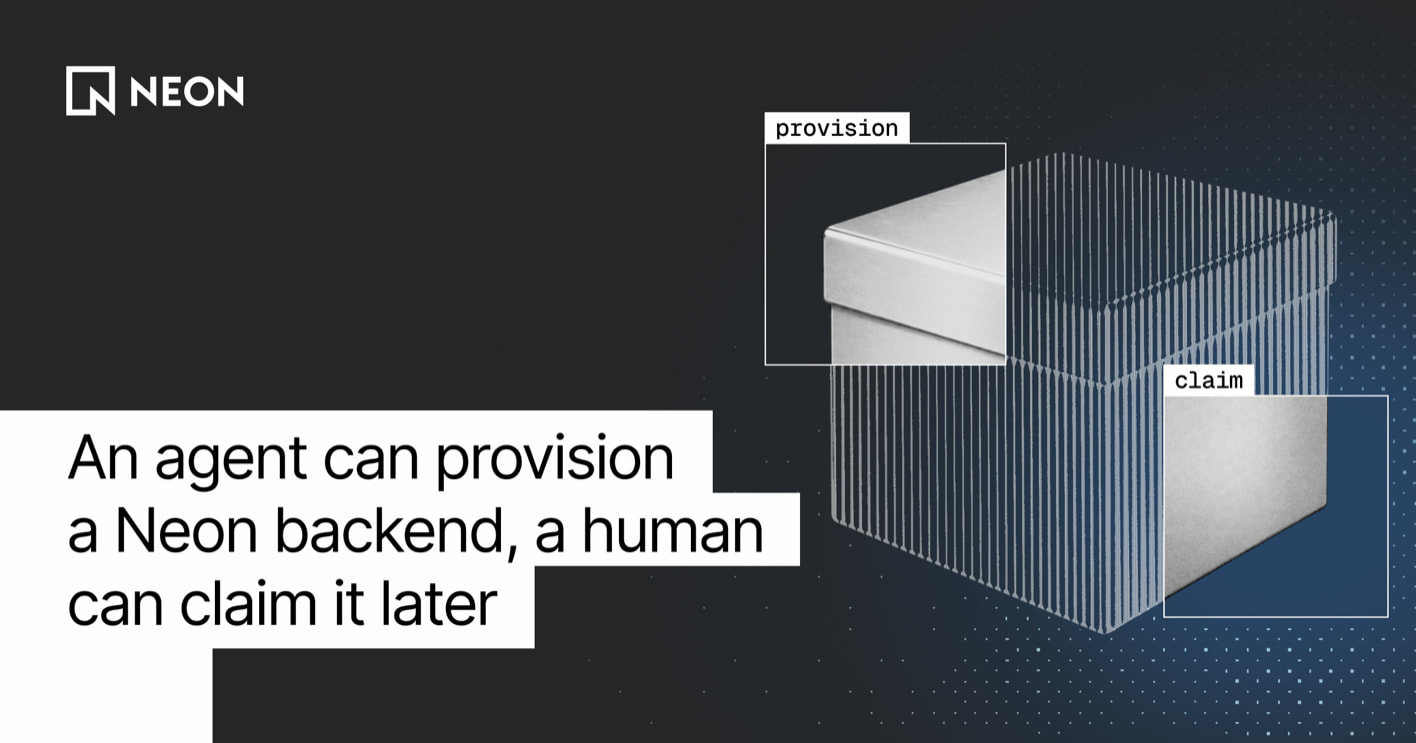
We're launching Claimable Neon to give the agent another path. This flow implements the anonymous registration method in auth.md, the open agent registration protocol authored by WorkOS, to give agents a way to provision a temporary Neon project without creating an account or collecting payment details. The agent gets credentials scoped to that project and keeps building. If you like the result, you can sign in later and claim the project into a Neon organization.
Today, agents can deploy Neon databases (Lakebase Postgres), the Data API, and Managed Better Auth via Claimable Neon, with the rest of the Neon backend services (Object Storage, Functions, and AI Gateway) coming soon.
Deploy a Neon backend before an account
Claimable Neon separates provisioning from ownership:
- The agent discovers the path: It starts with
llms.txt, then readsneon.com/auth.mdto learn how Claimable Neon works. - The agent provisions a project:
neon claim createregisters anonymously, creates one temporary project, and returns credentials scoped to that project. - The agent builds: It can connect with standard Postgres clients, run SQL, create branches, and configure the Data API or Managed Better Auth if the app needs them.
- A human claims it: The agent generates a short-lived claim link. The human signs in to Neon, selects an organization, and accepts the transfer.
An unclaimed project will expire after 72 hours, and it is capped at 100 MB of storage and 1 GB of transfer. Those limits keep the anonymous path useful for prototypes while keeping resource usage contained. As soon as a claim begins, Neon revokes the pre-claim access tokens and rotates the database credentials. Managed Better Auth and the Data API also transfer with the project if the agent enabled them.
Powered by auth.md
To build something like Claimable Neon, you need to guide agents beyond the API docs. They need to know how to register, which flows a service accepts, which capabilities they can request, and how to obtain credentials without pretending to be a human. auth.md provides that guide.
WorkOS authored auth.md, but the protocol is not tied to WorkOS infrastructure - any service can publish it, and any agent can read it. It composes existing OAuth standards with a registration layer designed for agents.
How it works:
- A service publishes a Markdown file, usually at
https://service.example.com/auth.md, with instructions for agents to follow. - The file points the agent to structured OAuth metadata that defines the actual endpoints and supported flows.
- The agent uses that metadata to register, receives a service-signed identity assertion, and exchanges the assertion for a short-lived, scoped access token. It can exchange the same assertion again when the access token expires, without sharing a human's existing Neon API key.
The protocol supports three registration methods:
- Agent verified: an agent provider vouches for a signed-in user.
- User claimed: the agent waits while a human signs in and confirms a code.
- Anonymous: the agent starts with limited access, then offers a claim flow if the human wants to keep the result.
Claimable Neon uses the Anonymous method.
Read the WorkOS story
Get the full story by WorkOS on how Claimable Neon implements auth.md.
Why we chose anonymous registration
An allowlist of known agent products would have been the more predictable launch: we could recognize requests from a handful of providers and reject everything else. But we actually want to see what happens when the instructions are public and the first interaction does not require a human identity. Which agents discover the file? What do they request? How far do they get? Do they ask for a database, Auth, or the Data API? Which projects do humans decide to keep?
And anonymous registration does not mean unrestricted access. The agent receives credentials for one temporary project, capabilities have explicit grant decisions, access tokens are short-lived and revocable. As we've mentioned, we've also set things up so the project has a fixed lifetime and small quotas before claim. The project-scoped Neon API key stays inside Claimable Neon and is never returned to the agent.
From neon.new to Claimable Neon
If you've been following Neon for a while, you might recognize the predecessors of Claimable Neon: we've been experimenting with these claimable workflows for a while, with projects like neon.new or Instagres. This was built for developers: for example, they used it in workshops and demos to create an ephemeral Postgres database without stopping for signup.
Claimable Neon keeps that useful split between creation and ownership, but changes who the first user is. If neon.new was an unauthenticated endpoint for developers, claimable Neon is a service for agents. Just like its predecessors - it is built on the Neon Open API. This time using the new @neon/sdk.
Since agents are the main access point now, Claimable Neon will eventually replace neon.new.
Ask your agent to try it
To try it, point your agent at neon.com/docs/llms.txt or ask it to create a Neon project for an app when you do not yet have a Neon account.
Under the hood, the CLI path looks like this:
npm i -g neon@latest
neon skills -s neon -s neon-postgres
neon claim create --service data-api --service auth --env-pull
The agent can then use existing Neon commands:
neon branches list
neon checkout dev
neon env pull
neon claim accept --no-open
PS: If the agent already has access to a Neon account, it should use that account. Claimable Neon is the path for the moment before an account exists and the human is not around to create one.
We loved collaborating with WorkOS to build Claimable Neon. If you're building something similar, make sure to check out auth.md.