




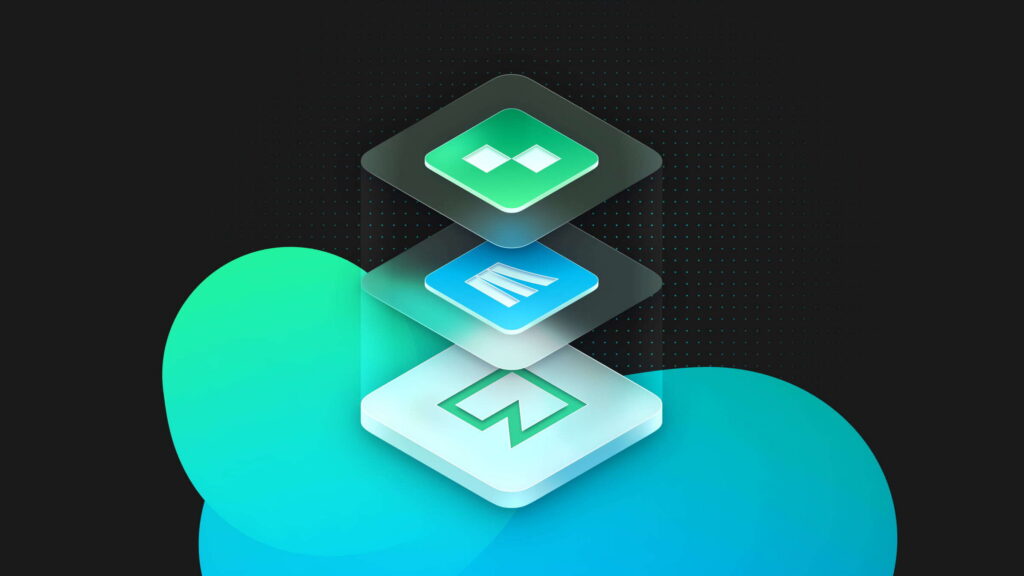
Neon and Encore are long-time partners
Neon was one of the first Postgres options offered in Encore Cloud, and we’re proud to continue supporting Encore as they expand into the agent era with Leap.
From the start, the team at Encore has been focused on solving a simple problem: shipping production infrastructure shouldn’t require a dedicated platform engineering team. They set out to make deploying real applications feel simple without abstracting away control; in Encore, devs can define infrastructure directly in Go or TypeScript, and the platform turns that into real cloud resources deployed to their own AWS or GCP accounts.
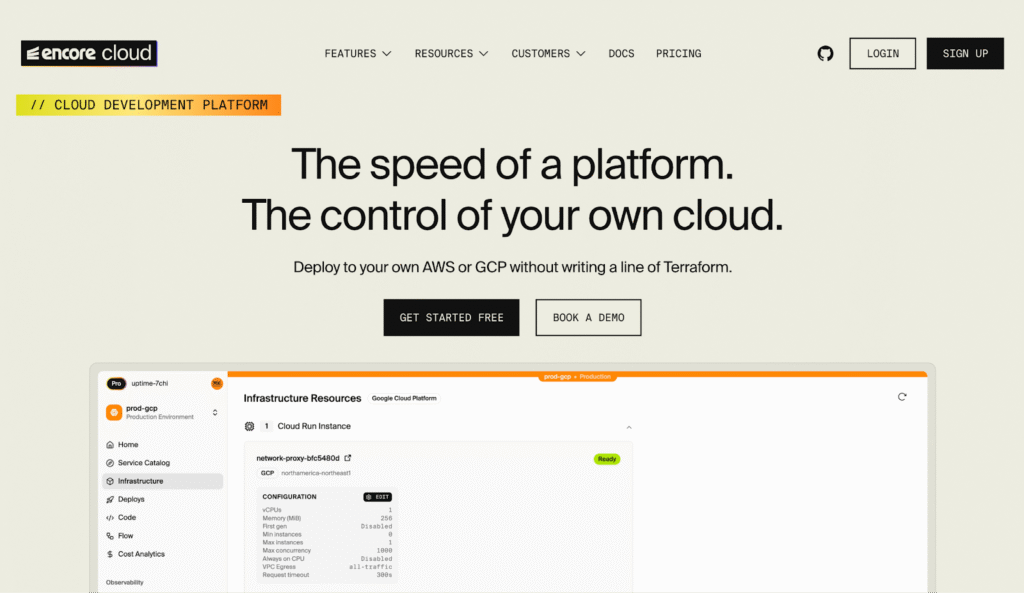
When agents started generating more and more of the application code, Encore already had the right primitives in place. Because building an app is only half the challenge; deploying it to real, scalable infrastructure is the other half.
Leap, by Encore – an agent built by devs, for devs
Answering the new wave of AI application builders, Encore just launched Leap, a full-stack agent that builds directly on top of Encore’s infrastructure model.
You may be thinking, sounds like another AI builder – but Leap is different: it’s built for developers and designed for real production workflows from the very beginning. Applications generated by Leap aren’t confined to a proprietary Platform as a Service like Supabase, they’re built to deploy through Encore Cloud into real cloud infrastructure in your own cloud on AWS and GCP.
Build first, deploy second – on real infra
Leap generates complete applications without skipping the parts that matter in production. That includes backend services (Go or TypeScript), APIs and service boundaries, database schemas, infrastructure definitions, and background jobs or pub/sub integrations.
During the building and iteration phases, applications first run in Encore preview environments, keeping infrastructure lightweight and isolated, with early database layers run in-memory for fast iteration. When you’re ready to ship,
- The app is deployed via Encore Cloud
- Infra is provisioned in your own AWS or GCP account, with no structural rewrite required to “graduate” from demo to production
- At deployment time, developers select infrastructure components from Encore Cloud’s catalog, including Neon as a Postgres database option
Edit when you need it: in-browser code editor
Leap also comes with a full-featured in-browser development environment for direct manual edits when you need more control. It includes full syntax highlighting, autocompletion, and real-time error checking, making it easier to refine AI-generated code without leaving the workflow.
Ship with GitHub: two-way sync, commits, and PRs
If you want to ship what you build, you’ll probably be pushing it to GitHub. So Leap integrates directly with it, without any “export your code” paywall. The integration supports a workflow that mirrors how devs work on their own codebases:
- Connect to any existing GitHub repository
- with two-way sync with your codebase,
- and automatic commits and PRs
Developer tooling built in
Leap and Encore both include built-in developer tools that support production readiness, including built-in tracing and automated API documentation and testing.
Preview Environments by Encore: powered by Neon branching
“Our users were asking for preview environments that already had their data in place. Neon’s branching was exactly what we needed: it lets us copy databases very quickly so teams can validate changes end to end immediately” (Marcus Kohlberg, Founder at Encore)
Neon’s partnership with Encore doesn’t end in the Encore Cloud catalog. Long before Leap, Encore was already using Neon to power one of the most loved features of the platform – Preview Environments.
Any engineering team will expect every code change (whether written by a human or an agent) to be validated before shipping it to production. In order to do that consistently and with enough confidence, it’s very valuable to be able to spin up a realistic full-stack environment where code can run end to end before merging.
This, of course, includes realistic database state – and Neon branches are exactly what you need to duplicate database environments.
Quick primer on Neon branching
If you’re new to Neon, a branch looks like a full logical copy of a Postgres database (including both schema and data) created instantly.
This is only possible because of Neon’s unique serverless architecture, with decoupled compute and storage and a copy-on-write storage design that preserves all history. Under the hood, branches share the same underlying storage layer as their parent. Instead of copying all data files, a branch simply references the existing data pages and only diverges when new writes occur, making branch creation effectively instant – regardless of how much data you’re “replicating” in your environment.
For workflows that require isolation, testing, or experimentation, branching turns the database into something you can version and duplicate as easily as code.
How Encore uses Neon branches for preview environments
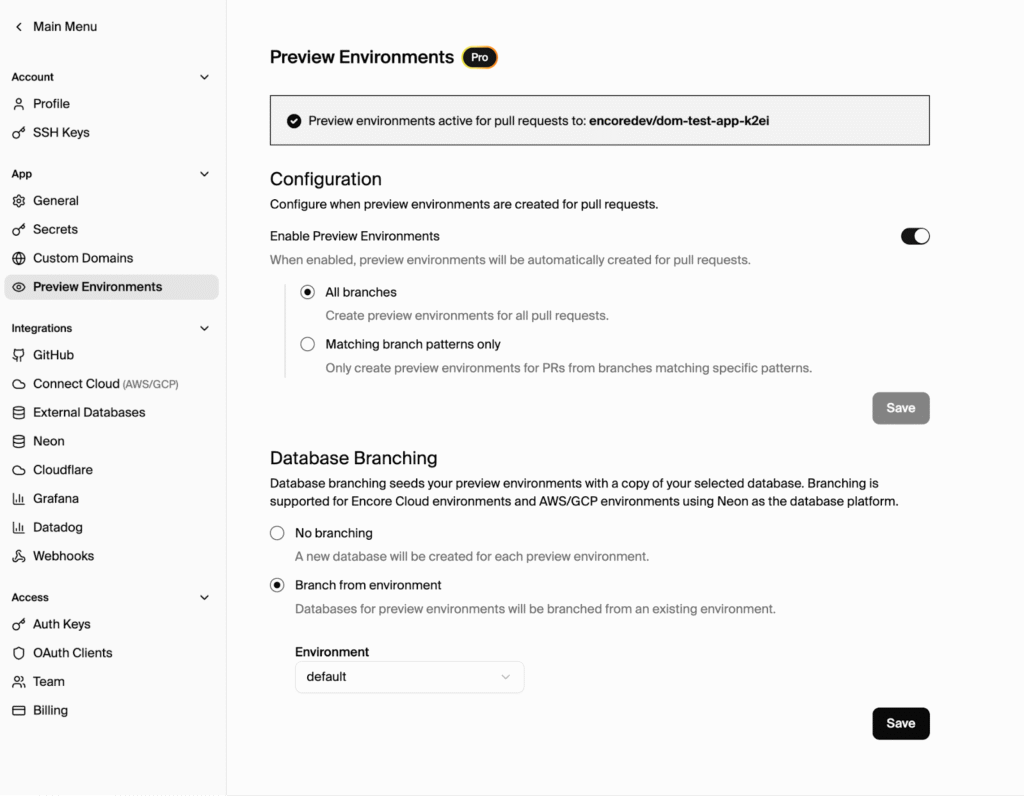
Encore’s preview environments are designed to provide full-stack validation for every change. When a preview is created,
- Encore provisions an isolated application environment.
- Neon creates a branch from an existing database (for example, a staging or production branch)
- The preview environment connects to that branched database
- The database scales to zero when idle, keeping previews cost-efficient
The result is preview environments that are truly production-grade, reflecting the real state of the app. Encore developers use them to validate migrations, test API changes against real schema and data, and run full integration tests without impacting live systems.
Try it
Leap takes care of building full-stack applications with AI, Encore makes it possible to deploy them to real cloud infrastructure, and Neon powers the database layer – from preview environments to prod. If you’re experimenting with AI-built apps but care about shipping real software, this is a stack worth trying – get started by building your first app with Leap.
Building a platform or agent that deploys real apps?
If your platform or agent provisions infrastructure, spins up environments, or deploys full-stack applications, consider partnering with Neon as your Postgres deployment layer. Learn more about Neon's Agent Plan and how to integrate Neon into your platform.